Have you ever watched a child give up because something feels just too hard?
Or perhaps you’ve seen the opposite: a child flies through an activity without really having to think.
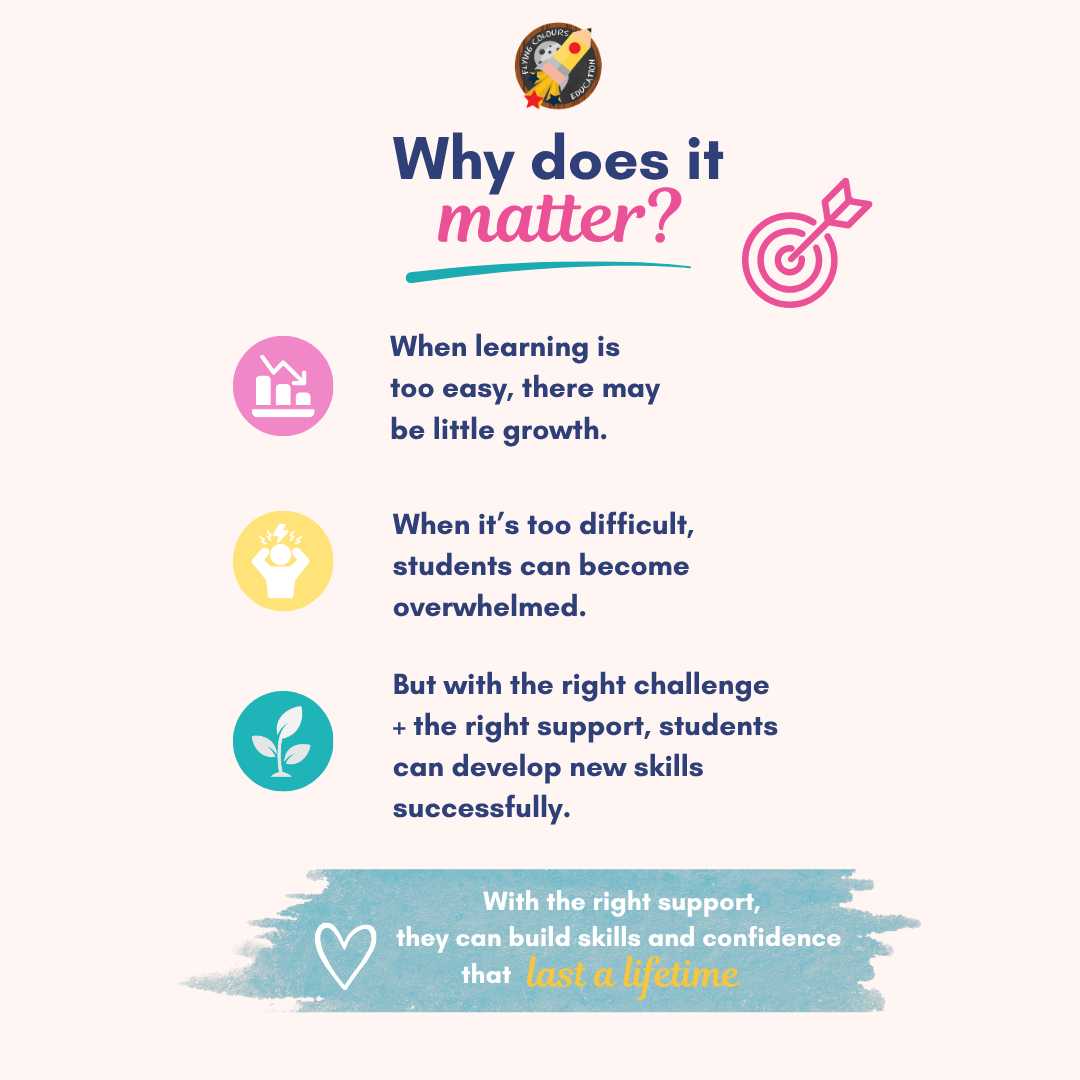
Neither situation creates the ideal conditions for learning.
For children to make meaningful progress, learning needs to provide just the right amount of challenge. It should stretch their thinking without overwhelming them.
This is where the Zone of Proximal Development, or ZPD, becomes important.
At Flying Colours, understanding what a child can do independently, where they need support and when they are ready for greater challenge helps us provide learning experiences that are targeted to the individual child. Not simply their age or year level.
What Is the Zone of Proximal Development?
The Zone of Proximal Development is a concept developed by psychologist Lev Vygotsky.
Put simply, we can think about learning in three zones:
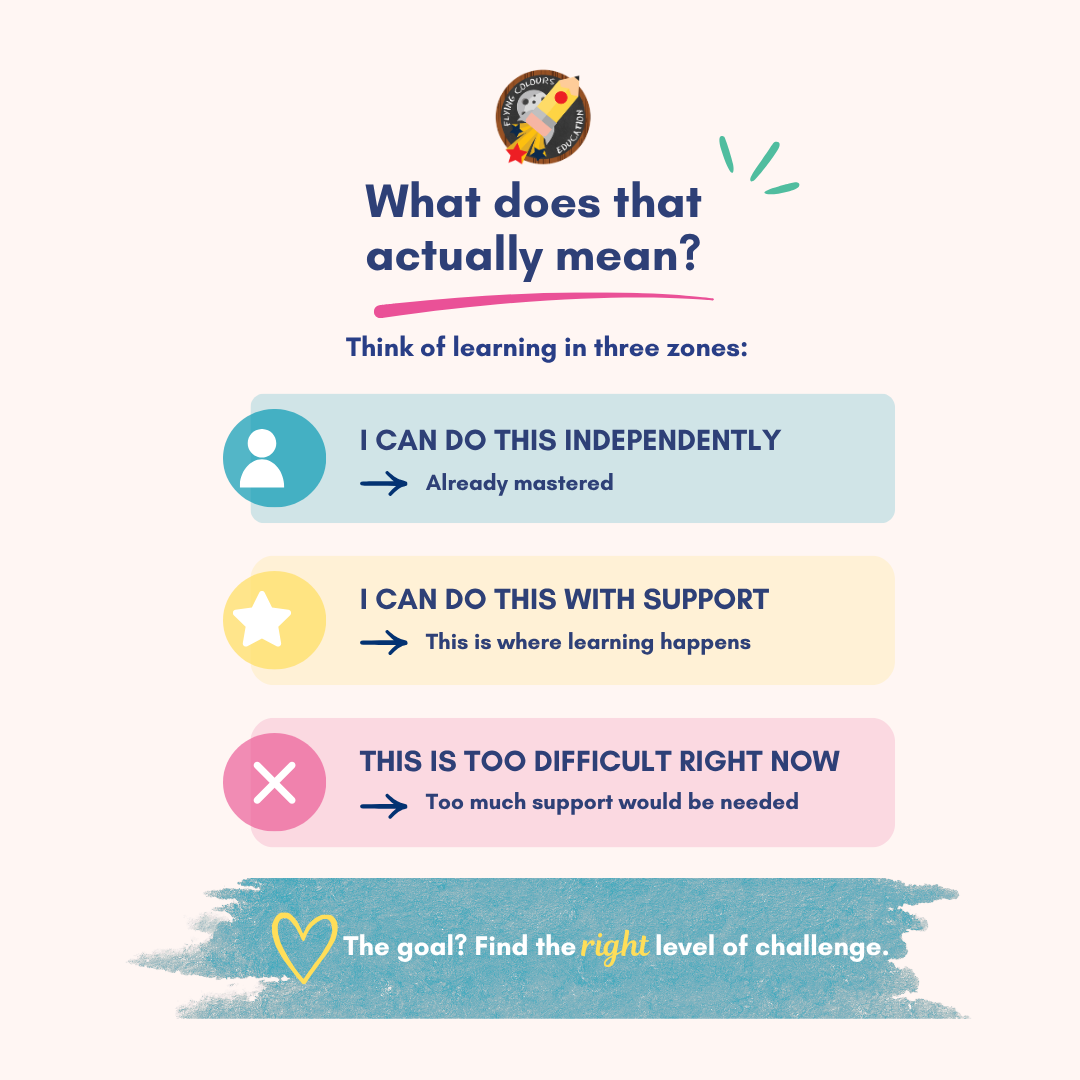
What a child can already do independently
These skills are already secure. Practising them can build fluency and confidence, but staying here all the time may not lead to significant new learning.
What a child can do with appropriate support
This is the Zone of Proximal Development. The task is challenging, but achievable when the child receives the right guidance, modelling, prompts or scaffolding.
What a child cannot yet do, even with support
At this point, the learning demands may be too great. The child may become confused, frustrated or overwhelmed because important prerequisite skills have not yet been established.
Effective learning support aims to spend meaningful time in that middle zone. Where learning is challenging enough to promote growth but supported enough for the child to experience success.
Why Does the ZPD Matter for Children with Learning Difficulties?
For a child with learning difficulties, their current skill level may not match the work typically expected for their age or school year.
Giving them more year-level work without addressing missing foundations can therefore create frustration rather than progress.
Imagine a child struggling with multiplication because their understanding of number relationships and repeated addition is not yet secure.
Simply giving that child additional multiplication worksheets may provide more practice, but not necessarily better learning.
Specialised learning support looks underneath the difficulty.
What does the child already understand?
Where does their understanding begin to break down?
Which prerequisite skills need strengthening?
What can they achieve when appropriate support is provided?
Finding that point allows us to teach from where the child actually is, rather than where they are expected to be.
The Science Behind the Zone of Proximal Development
Vygotsky’s theory emphasised the social nature of learning and the important role a more knowledgeable person can play in helping a learner achieve something they could not yet accomplish independently.
This principle has had a significant influence on educational practice.
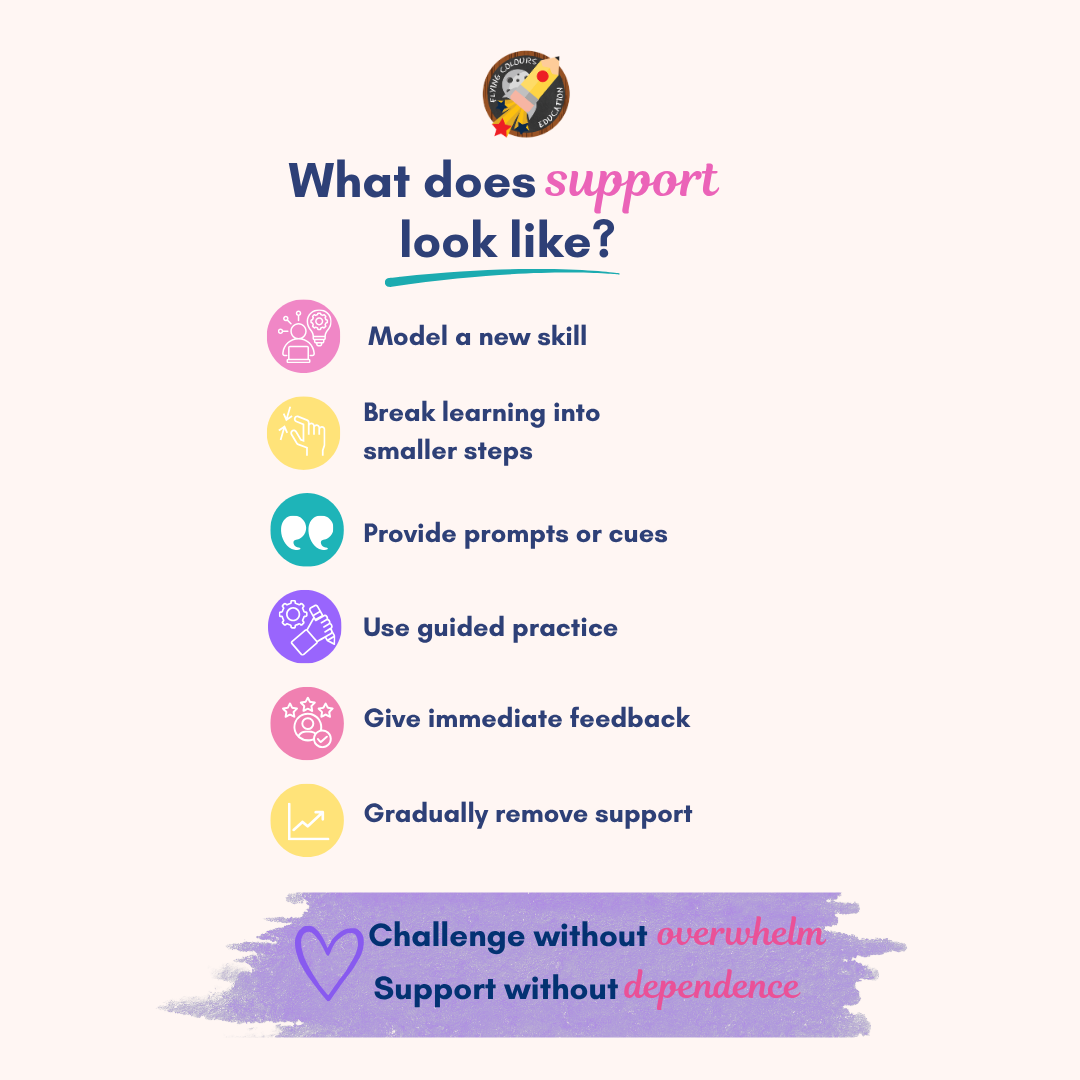
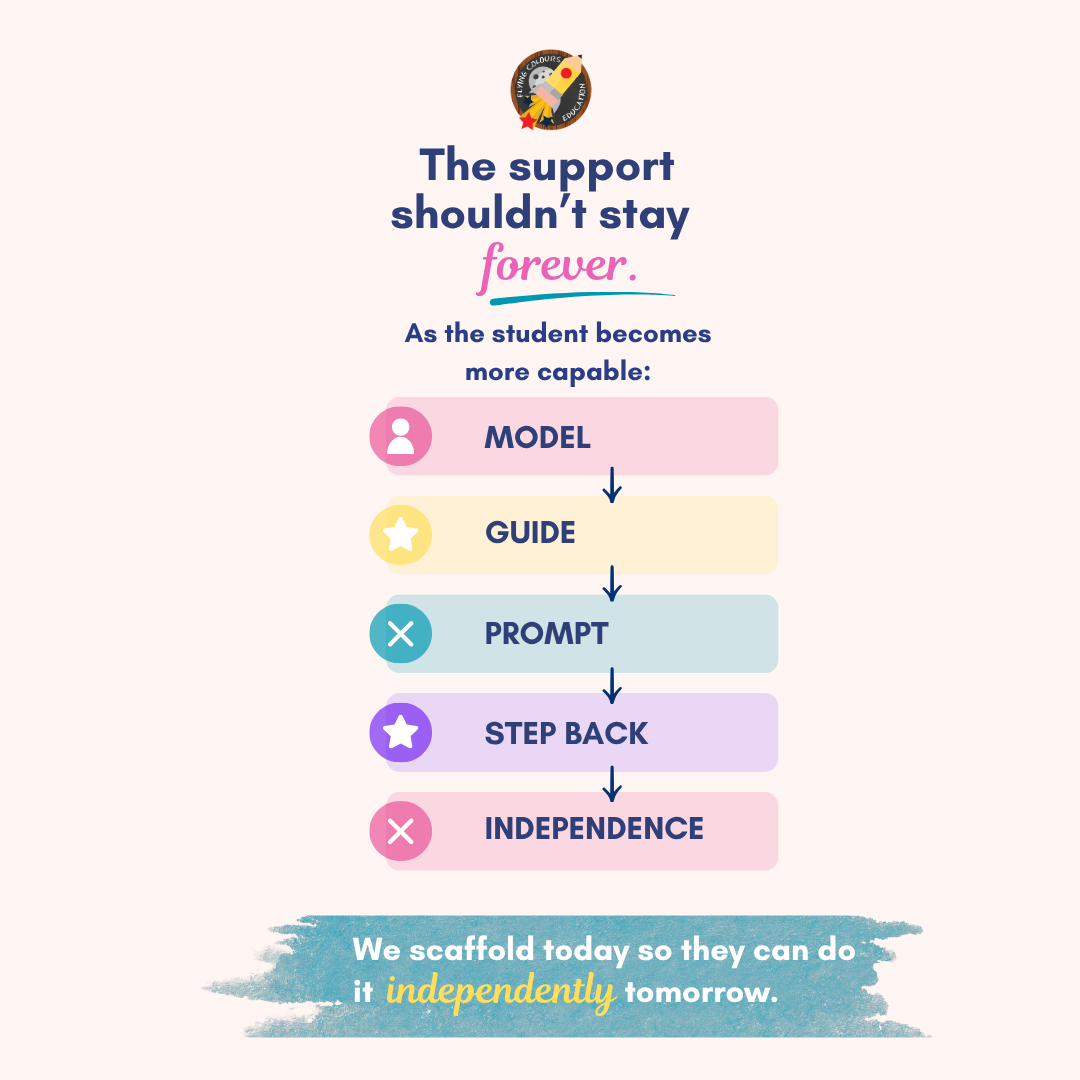
It is closely associated with the concept of scaffolding: providing appropriate support while a child is developing a new skill, then gradually reducing that support as their knowledge and independence increase.
That support might involve:
-
explicitly modelling a skill
-
breaking a task into smaller steps
-
providing visual prompts
-
asking carefully chosen questions
-
completing part of a task together
-
giving immediate feedback
-
providing guided practice
-
gradually increasing complexity
The goal isn’t to make learning easy.
The goal is to make challenging learning accessible.
The Importance of Cognitive Load
The ZPD also fits closely with what we understand about cognitive load.
Children can only process a limited amount of new information at one time. For children experiencing working memory, processing, language or attention difficulties, an activity containing too many unfamiliar elements can quickly become overwhelming.
When this happens, we may see a child:
-
shut down
-
guess
-
become distracted
-
avoid the task
-
become frustrated
-
say, “I can’t do it”
These behaviours don’t necessarily mean a child isn’t capable of learning the skill.
The learning may simply need to be broken down differently, explicitly taught or supported more carefully.
How We Find a Child’s Learning Zone at Flying Colours
Finding the right level of challenge isn’t guesswork.
At Flying Colours, we draw on assessment, data and ongoing observation to understand each child’s current skills and learning needs.
During sessions, we’re continually noticing things such as:
- What can the child complete independently?
- Where do they begin to hesitate?
- What errors are they making?
- What strategies are they using?
- How much prompting do they need?
- What happens when we change the way something is explained?
- Are previously taught skills becoming automatic?
- Is the child ready for the next layer of learning?
This information helps our educators continually adjust instruction.
If something is too easy, we can increase the challenge.
If something is too difficult, we can provide additional scaffolding or return to an underlying skill.
And as a child’s skills develop, their Zone of Proximal Development moves with them.
From “I Can’t” to “I Can”
There is also an important emotional element to getting the level of challenge right.
Many children who come to learning support have already experienced repeated difficulty at school.
They may have begun to associate learning with failure.
When a child repeatedly works outside their current learning zone, they can start believing:
“I’m bad at maths.”
“I can’t read.”
“Everyone else can do this except me.”
But when learning is appropriately challenging and the right support is provided, something different begins to happen.
“I can’t do this” becomes “I can do this with some help.”
And eventually:
“I can do this myself.”
Those experiences of genuine success are incredibly important for rebuilding confidence.
Why This Is Different from Traditional Tutoring
This is another important distinction between specialised learning support and traditional tutoring.
Tutoring commonly begins with the work a child is currently completing at school.
Learning support begins with the learner.
Instead of simply asking:
“What is the class working on this week?”
we also need to ask:
“What does this child need to learn next?”
Sometimes those things will align.
Sometimes the most valuable intervention is to step back and strengthen an earlier foundational skill so the child can eventually access more complex learning successfully.
This isn’t about lowering expectations.
It’s about creating the pathway that allows a child to reach them.
How the ZPD Connects to the Flying Colours Approach
The Zone of Proximal Development doesn’t sit in isolation. It connects many of the evidence-informed practices we use throughout our programs.
Observation helps us recognise where learning begins to break down.
Data-driven support helps us identify skills requiring intervention and monitor progress.
Explicit instruction allows us to clearly model new knowledge and strategies.
Layered learning ensures new skills are built on secure foundations.
Multisensory approaches can provide additional pathways for children to access and practise learning.
And ongoing assessment tells us when a child is ready for the next challenge.
Together, these approaches allow us to meet children where they are—and help them move forward.
The Right Support Changes What’s Possible
Children don’t need learning that is permanently easy.
And they don’t benefit from repeatedly being given work that leaves them feeling defeated.
They need challenge accompanied by the right support.
At Flying Colours, our role is to understand each learner, identify the next meaningful step and provide the instruction and scaffolding needed to help them reach it.
As their knowledge, skills and confidence grow, we gradually step back.
What once required support becomes something they can do independently.
And then it’s time to find the next zone of possibility.
Looking for Learning Support?
If your child is working hard but continuing to struggle, more practice isn’t always the answer.
Specialised learning support can help identify where learning is breaking down, strengthen the foundations underneath it and provide targeted instruction at a level where genuine progress can occur.