Learning Assessments
Understanding your child’s strengths, challenges and next steps
Why Assessments Matter
At Flying Colours Education, we believe effective support begins with understanding.
Our assessments are designed to identify a child’s strengths, areas of need and current level of achievement so that support can be tailored to their individual learning profile. Rather than making assumptions, we use assessment data to guide our recommendations, personalise learning programs and measure progress over time.
Assessments help us establish a clear baseline of where a child is currently performing, what skills they have mastered and which areas may require further support. This information allows us to develop targeted programs that focus on the skills a child actually needs, rather than spending valuable time and money revisiting concepts they have already mastered.
Assessments also allow us to track progress over time and provide families with meaningful feedback about their child’s growth and development.
In some cases, assessments may highlight indicators commonly associated with learning difficulties such as dyslexia, dysgraphia, or dyscalculia. While Flying Colours Education does not diagnose learning difficulties, we can discuss any concerns with families and provide guidance regarding appropriate next steps where further investigation may be beneficial.

Literacy Essentials Assessment
The foundation of reading and spelling success
Assesses:
✔ Phonological Awareness
✔ Letter-Sound Knowledge (Phoneme- Grapheme Correspondence
✔ Reading Accuracy and Fluency
✔ Spelling Skills
✔ Decoding Skills (Reading Unfamiliar Words
✔ Encoding Skills (Spelling & Written Word Construction)
✔ Indicators of potential learning difficulties
Ideal for students experiencing difficulties with reading and spelling or those beginning literacy support
Literacy Additional Assessment
Looking beyond reading and spelling
Assesses:
✔ Reading Comprehension
✔ Understanding of Different Comprehension Skills
✔ Writen Expression
✔ Creative Writing
✔ Organisation of Ideas
✔ Written Language Skills
✔ Indicators of potential learning difficulties
Often completed when further investigation is rquired beyond reading and spelling skills.
High School Literacy Assesment
Designed for secondary students
Assesses:
✔ Reading Comprehension
✔ Written Expression
✔ Literary Devices
✔ Grammar and Parts of Speech
✔ Spelling
✔ Text Analysis Skills
✔ Indicators of potential learning difficulties
Numeracy Assessment
Understanding mathematical strengths and learning gaps
Assesses:
✔ Number Sense
✔ Subitising
✔ Estimation
✔ Addition and Subtraction Strategies
✔ Place Value
✔ Multiplication and Division Strategies
✔ Fractions
✔ decimals
✔ Percentages
✔ Problem Solving
✔ Mathematical Reasoning
✔ Indicators of potential numeracy-based difficulties
This assessment helps identify whether a child is performing below, at or above expected grade-level standards and assists in identifying potential indicators associated with dyscalculia and other learning difficulties.
What Happens After the Assessment?
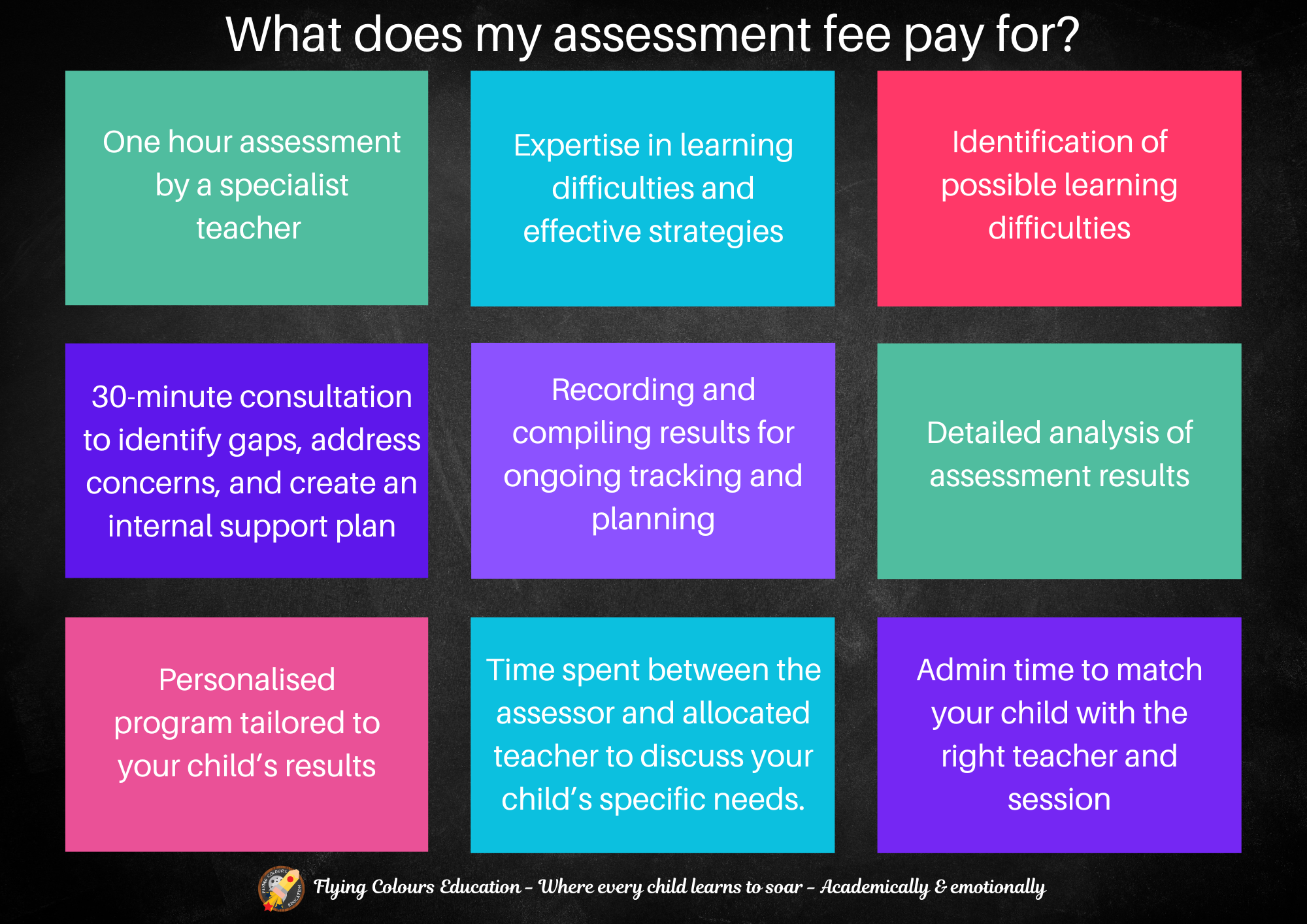
Following the assessment, families receive feedback regarding their child’s strengths, areas of need and recommended next steps.
Where appropriate, assessment results are used to develop a personalised learning pathway and place students into the most suitable Flying Colours program. In some cases, recommendations may include additional support, further assessment or referral to other professionals.
Our goal is simple: to ensure every child receives the right support, at the right level, at the right time.