I’ve been thinking a lot lately about breaks.

Not school holidays. Not taking a week off because you’re going away. And certainly not the importance of giving children time to rest, play and simply be kids.

I’ve been thinking about the longer breaks families sometimes decide to take from learning intervention.

“We thought we’d give them a term off.”

“They’ve been doing it for a while now. They probably need a break.”

“We’ll see how they go on their own and come back if they start struggling again.”

I completely understand the thinking behind it.

When your child has been attending learning support week after week. Sometimes for months or years. It can feel like a lot. Families have busy schedules. Children have sport, friends and other commitments. There is also a very understandable hope that perhaps your child has reached a point where they can manage without intervention.

But lately, I’ve been reflecting on what we see happen after some of those breaks.

And I think it’s a conversation worth having.

Progress Isn’t Always Obvious

One of the difficult things about intervention is that progress doesn’t always look dramatic from the outside.

When a child has significant gaps in their learning, we may be working on skills that should have developed years earlier while their school year continues moving forward.

So although that child is progressing, the finish line is moving too.

That can make it difficult for parents to see just how much has changed.

Sometimes we hear:

“They’re still getting a D.”

Or:

“They’re still behind everyone else.”

And I understand why that can feel discouraging.

But a school grade doesn’t necessarily show us how far a child has travelled.

The child who once couldn’t decode an unfamiliar word may now be doing so with support.

The child who counted every calculation on their fingers may now be retrieving some number facts automatically.

The child who once shut down as soon as work became difficult may now attempt it.

Those changes matter.

They are the layers we’re building on.

Learning Builds on Learning

Intervention isn’t a collection of unrelated activities.

Skills are deliberately taught, practised, revisited and strengthened so that one layer of learning can support the next.

When intervention stops for an extended period, that process stops too.

Newly developing skills don’t suddenly disappear the moment a child walks out the door. But skills that are not yet secure can become less fluent or harder to retrieve without continued opportunities to use and consolidate them.

And for a child who already needs more repetition and explicit teaching than their peers, regaining that fluency can take valuable time.

Sometimes, when a child returns after a significant break, we can’t simply pick up exactly where we left off.

We may need to revisit earlier learning.

We may need to determine which skills have remained secure and which have faded.

Depending on how long they’ve been away, we may even need to reassess so that we’re confident we’re restarting at the right point.

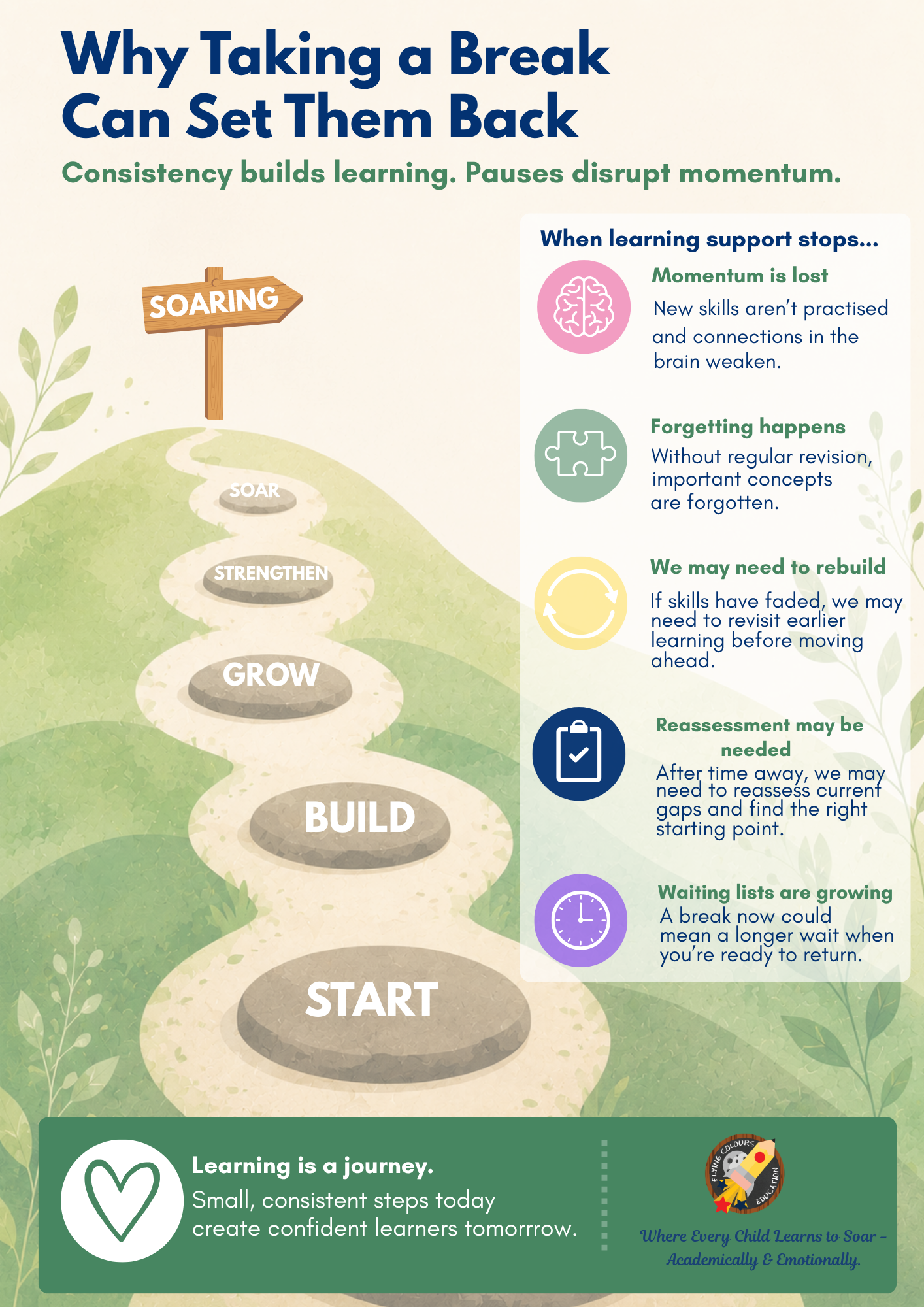
That’s why I wanted our families to understand the message behind the poster we’ve recently created:

Consistency builds learning. Pauses can disrupt momentum.

But Doesn’t My Child Need a Break?

Absolutely.

Children need rest.

They need holidays. They need afternoons when nobody asks them to read anything. They need to swim, play sport, see their friends, watch movies and occasionally spend far too long doing absolutely nothing.

Rest and intervention are not opposites.

A sustainable intervention program should recognise that children are whole people. Not academic projects.

What concerns me isn’t a holiday or the occasional missed session.

It’s the decision to stop intervention for a term, six months or longer when the underlying learning difficulty hasn’t disappeared.

Because there’s an important difference between resting and stepping away from the support a child still needs.

“We’ll Come Back If They Start Struggling”

This is probably the phrase that worries me most.

Because by the time the struggle becomes obvious, the child may already have spent months trying to cope.

The gaps haven’t remained still while they’ve been away. School has continued.

New content has been introduced.

Expectations have increased.

Their peers have continued learning.

And sometimes the first indication that things aren’t going well isn’t actually an academic result.

It’s:

“I hate maths.”

“I’m stupid.”

“I don’t want to go to school.”

“Everyone else gets it except me.”

That’s why I would much rather help a child maintain momentum than wait until things become difficult enough that they need rescuing again.

There’s a Practical Issue Too

There is another reality families need to consider.

A place may not still be available when you’re ready to return.

Our intervention groups progress together, and our available places can fill.

Depending on the length of the break and the child’s progress in the meantime, they may no longer be able to return to their previous group. They may require reassessment, a different group or, in some circumstances, individual support while we rebuild particular skills.

So when families say, “We’ll just come back if we need to,” I never want them to assume returning will necessarily mean stepping straight back into exactly the same place.

Progress Before Perfection

Perhaps this is the biggest thing I’ve been thinking about.

When a child still has a long way to go, it’s very easy to focus on the gap.

But sometimes we need to turn around and look at the distance they’ve already travelled.

What can they do today that they couldn’t do six months ago?

What requires less prompting?

What have they mastered?

Where has their confidence changed?

Intervention is rarely a straight line.

For many of our children, it’s a journey made up of hundreds of small steps.

Start. Build. Grow. Strengthen. Soar.

And every one of those steps counts.

So if you’re considering taking an extended break because you’re wondering whether intervention is still necessary, please talk to us first.

Ask us where your child started.

Ask us where they are now.

Ask us what we’re currently building towards.

And ask us what the implications of a break might be for your particular child.

Sometimes a change may be appropriate.

But let’s make that decision based on the child’s progress, their needs and the evidence we have—not simply because they’ve been doing intervention for a long time.

Because learning is a journey.

And those small, consistent steps can be exactly what eventually get them where they’re trying to go.