“They just need more practice.”
It’s something parents of children who struggle with learning hear all the time.
More reading. More spelling words. More maths questions. More worksheets. More homework.
And while practice is an essential part of learning, more practice isn’t necessarily better practice.
For children with learning difficulties in particular, simply repeating an activity may not address the reason they are struggling in the first place.
At Flying Colours, we believe in practice with purpose.
That means knowing exactly what we are practising, why we’re practising it, and how that practice will help a child move forward.
Because effective learning isn’t about how many worksheets a child completes.
It’s about what changes as a result.
Why Do Children Need Practice?
When children first learn something new, it requires considerable conscious effort.
Think about learning to read a new word, recall a number fact or apply a new spelling rule. Initially, the child has to actively think through each step.
With carefully structured practice, skills become increasingly accurate, fluent and automatic.
This matters because our working memory has limited capacity.
When foundational skills become more automatic, they require less conscious effort, leaving more mental capacity available for complex thinking.
A child who can decode words accurately and efficiently, for example, has more cognitive capacity available to think about the meaning of what they’re reading.
A child who can recall basic number facts efficiently has more capacity available for solving a multi-step mathematical problem.
Practice therefore has an important job to do.
But it needs to be the right practice.
What Is Practice with Purpose?
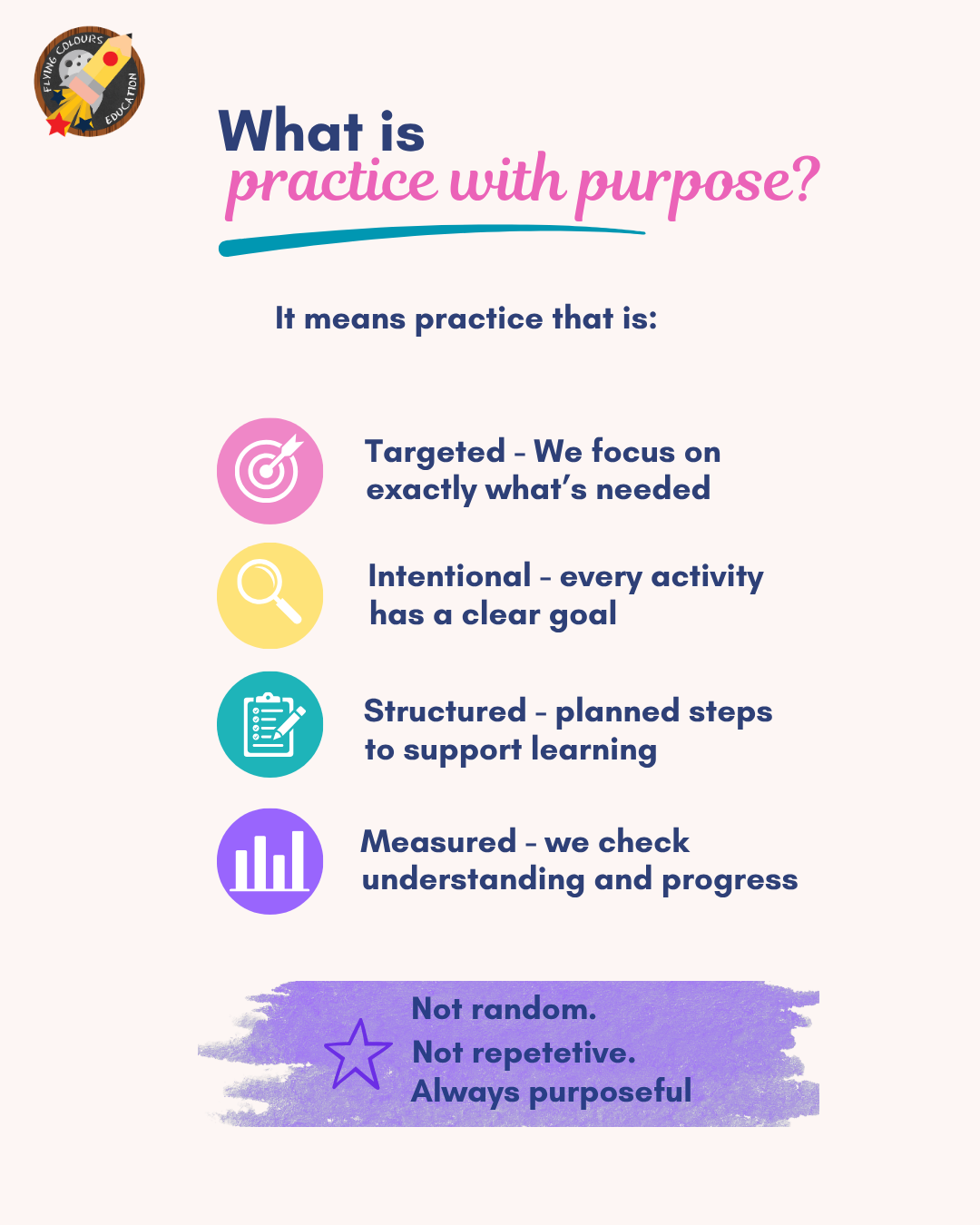
Purposeful practice isn’t simply repeating something over and over.
It is practice deliberately selected to strengthen a particular skill or area of learning.
Before asking a child to practise, we need to understand:
-
What skill are we trying to strengthen?
-
Does the child understand the concept first?
-
Is this the appropriate level of difficulty?
-
What errors is the child currently making?
-
How much support do they need?
-
Is the practice helping the skill become more accurate, fluent or independent?
-
When should we revisit it?
This turns practice from a generic activity into a targeted part of intervention.
Practice Should Follow Teaching
One of the most important principles at Flying Colours is that we don’t expect children to practise something they haven’t been properly taught.
Practice cannot replace explicit instruction.
If a child doesn’t understand a spelling pattern, giving them a longer spelling list isn’t necessarily going to solve the problem.
If a child doesn’t understand place value, completing another page of calculations may simply reinforce confusion.
If a child is guessing unfamiliar words rather than decoding them, asking them to “read more” doesn’t directly teach the missing decoding skills.
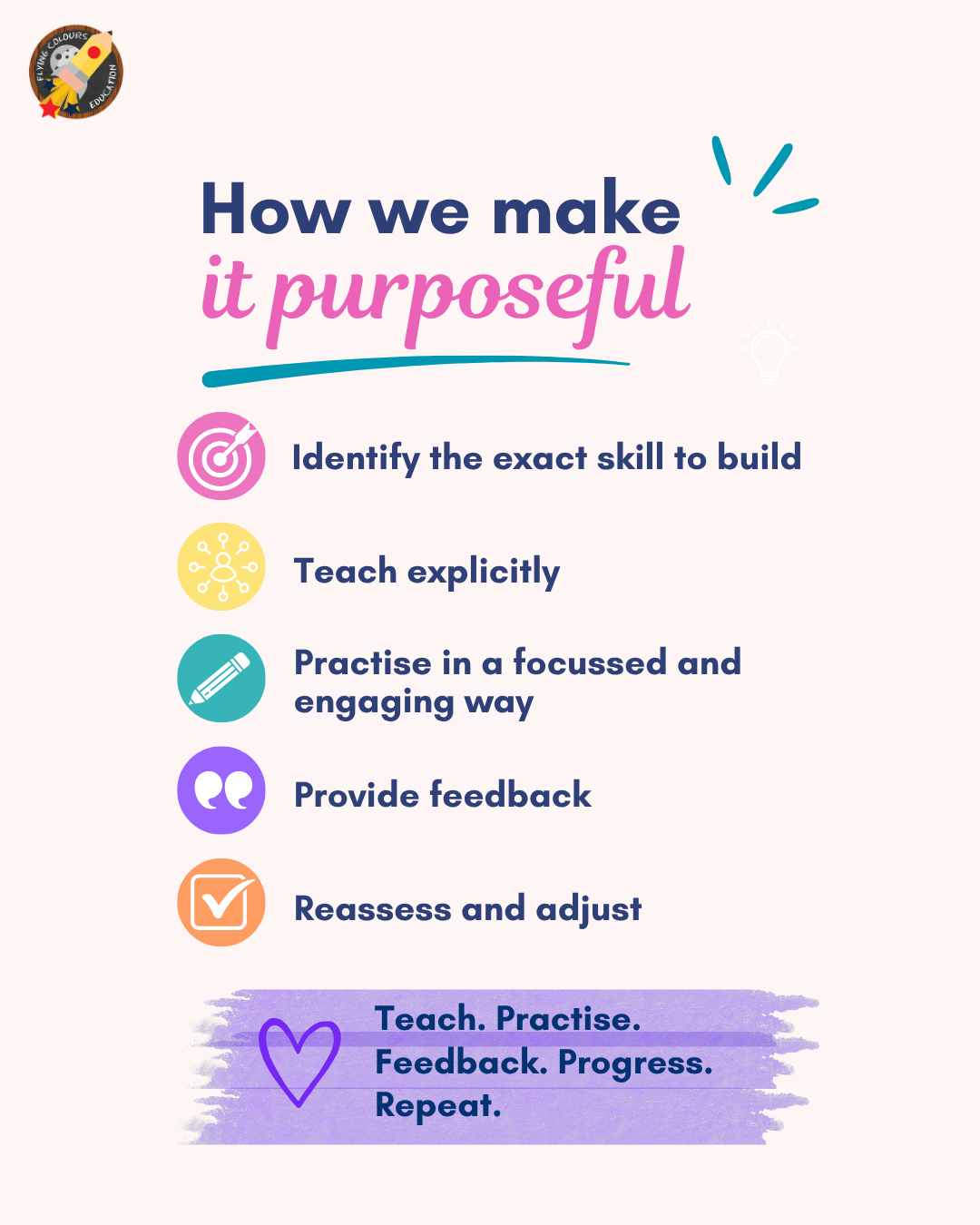
First, we identify the difficulty.
Then we teach the skill explicitly.
Then we provide guided practice.
And only as understanding develops do we gradually expect greater independence.
Why Repetition Alone Can Be a Problem
Repetition has an important role in learning—but repetition without understanding can be ineffective.
A child may complete dozens of questions using an incorrect strategy.
They may memorise an answer without understanding the concept behind it.
Or they may rely heavily on an adult’s prompts without developing independence.
In these situations, the child has certainly been busy.
But being busy isn’t the same as learning.
Purposeful practice gives educators opportunities to observe how a child is responding and make adjustments before misconceptions or ineffective strategies become embedded.
The Science Behind Effective Practice
Research from cognitive science has helped us understand that how practice is structured matters.
Several principles are particularly important.
Retrieval Practice
Retrieval practice involves actively bringing previously learned information back to mind rather than simply looking at it again.
Each time children successfully retrieve knowledge, the pathway to that information can become stronger and easier to access in the future.
Spaced Practice
Instead of practising something intensively once and then moving on, effective learning revisits important knowledge over time.
Spacing practice across multiple sessions supports longer-term retention and gives us opportunities to check whether learning has genuinely become secure.
Cumulative Review
New learning shouldn’t mean old learning disappears.
Purposeful practice regularly incorporates previously taught skills so children continue strengthening them while adding new knowledge.
This is particularly important for children who require more opportunities for consolidation.
Feedback
Practice is most useful when children receive timely, specific feedback.
Feedback allows errors and misconceptions to be addressed before they become established and helps children understand what successful performance looks like.
Why Purposeful Practice Matters for Children with Learning Difficulties
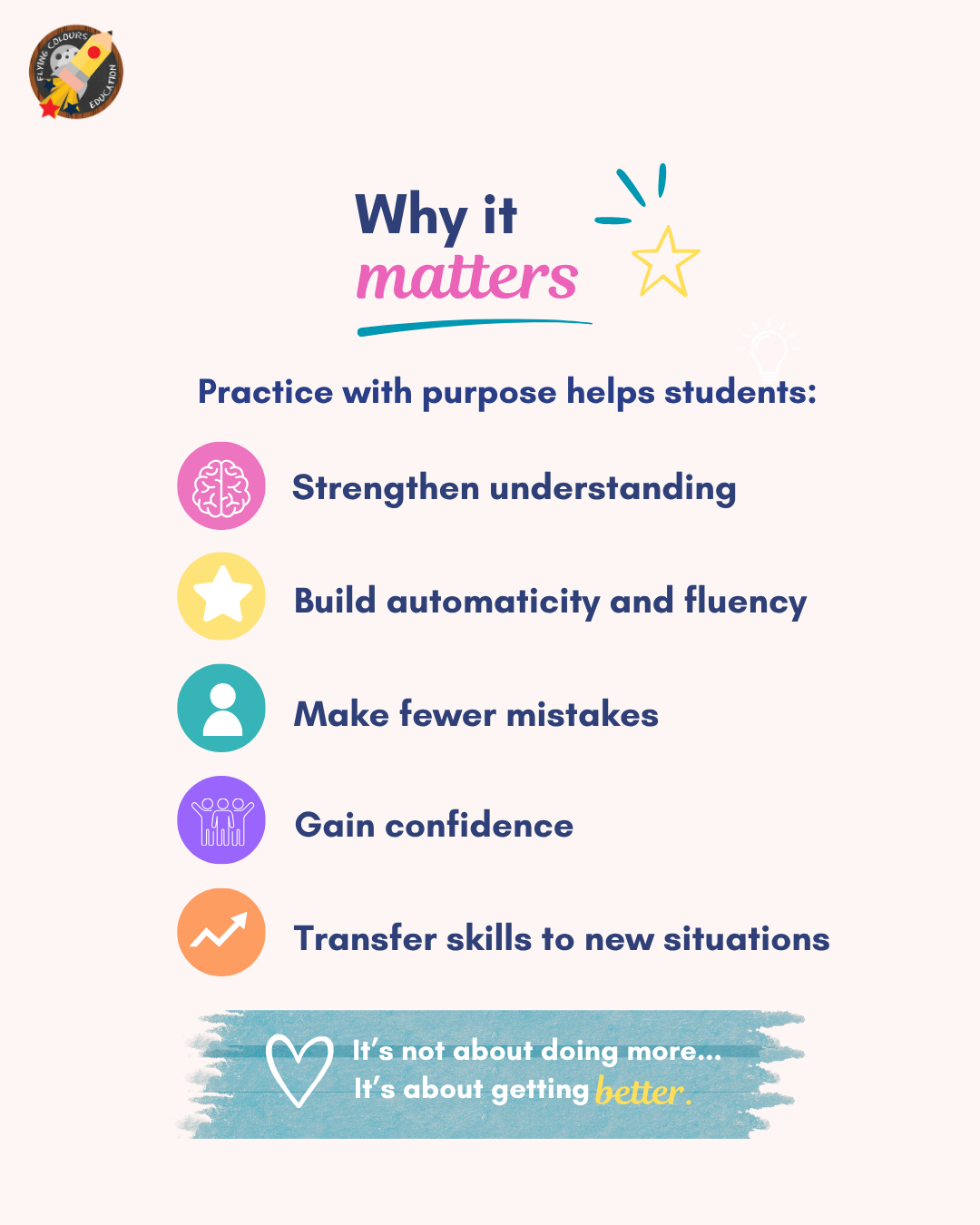
Children with learning difficulties may require more opportunities than their peers to consolidate and retrieve new knowledge.
But that doesn’t mean simply giving them more work.
In fact, repeatedly asking a child to complete tasks they find difficult can increase frustration and reinforce a sense of failure.
Effective practice needs to consider the child’s:
- current skill level
- working memory
- processing demands
- attention
- existing knowledge
- learning goals
- confidence
Sometimes ten carefully selected questions with immediate feedback will provide far more valuable learning than fifty repetitive questions completed incorrectly.
What Practice with Purpose Looks Like at Flying Colours
At Flying Colours, practice is connected to each child’s individual learning goals.
Our educators use assessment, data and ongoing observation to determine which skills require further development.
Practice may be designed to:
-
strengthen a newly taught skill
-
develop fluency and automaticity
-
revisit previous learning
-
address a specific misconception
-
apply a skill in a different context
-
strengthen retrieval from long-term memory
-
build independence
-
prepare a child for the next layer of learning
And because we continually monitor how children respond, practice can change as the child progresses.
We’re not simply asking, “Did they finish it?”
We’re asking, “What did they learn from it?”