When a child is struggling with schoolwork, the obvious response is often to focus on the task in front of them.
Can’t complete the maths homework? Help with the maths questions.
Struggling with a reading assignment? Help them read the text.
Finding writing difficult? Help them finish the paragraph.
But what if the task isn’t actually the problem?
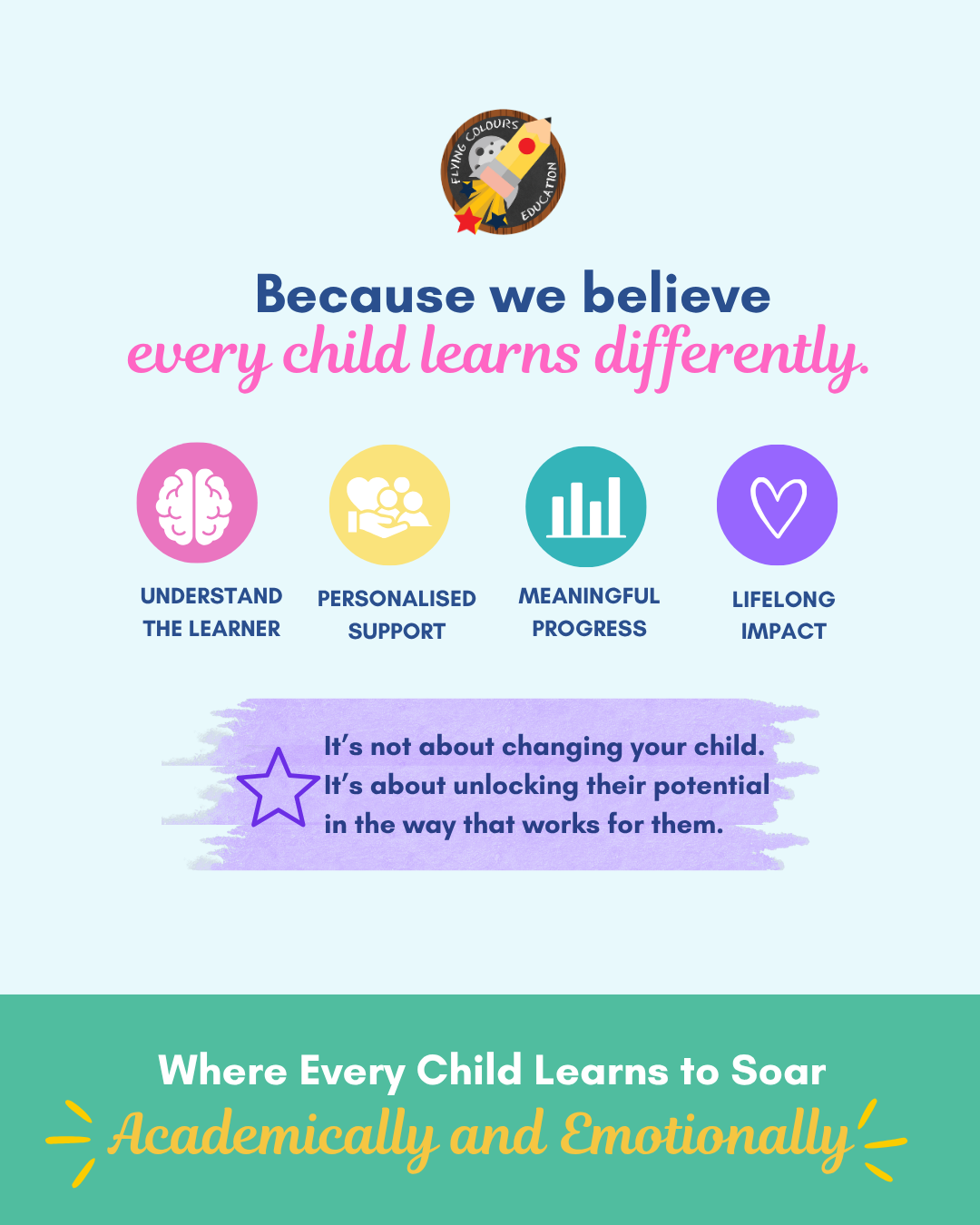
At Flying Colours, we look beyond what a child is struggling with today to understand how that child learns.
Because effective learning support shouldn’t simply help a child complete the task in front of them.
It should help them become a stronger, more independent learner.
Looking Beyond the Task
Two children can struggle with exactly the same classroom task for completely different reasons.
Imagine two students who are both having difficulty solving a maths word problem.
One may understand the mathematical concept but struggle to understand the language used in the question.
Another may understand the language but find it difficult to hold several pieces of information in working memory while solving the problem.
The task looks the same.
The difficulty looks the same.
But the underlying learning need is completely different.
If we only focus on completing the question, we may never identify that difference.
That’s why understanding the learner matters.
What Does It Mean to Understand a Child as a Learner?
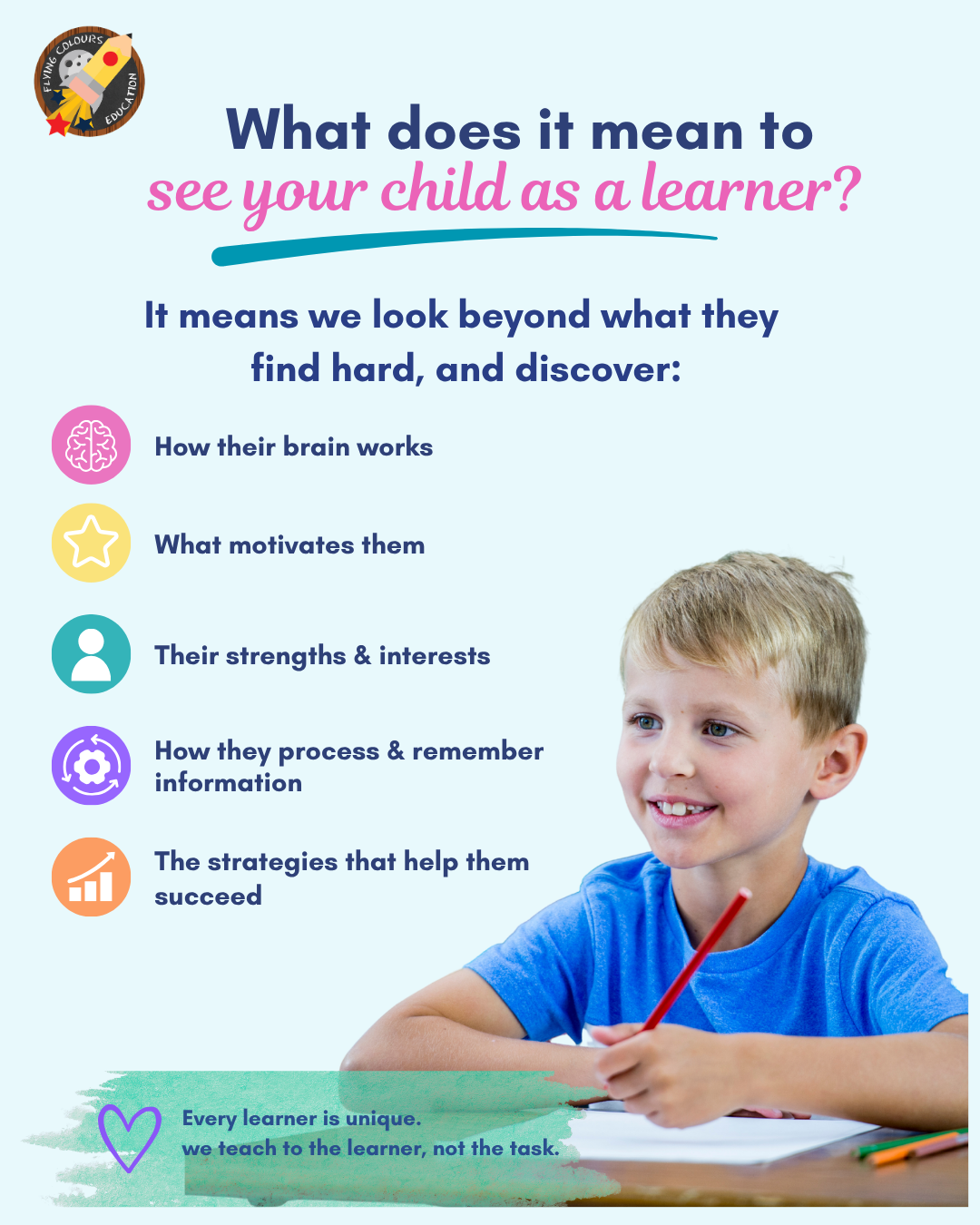
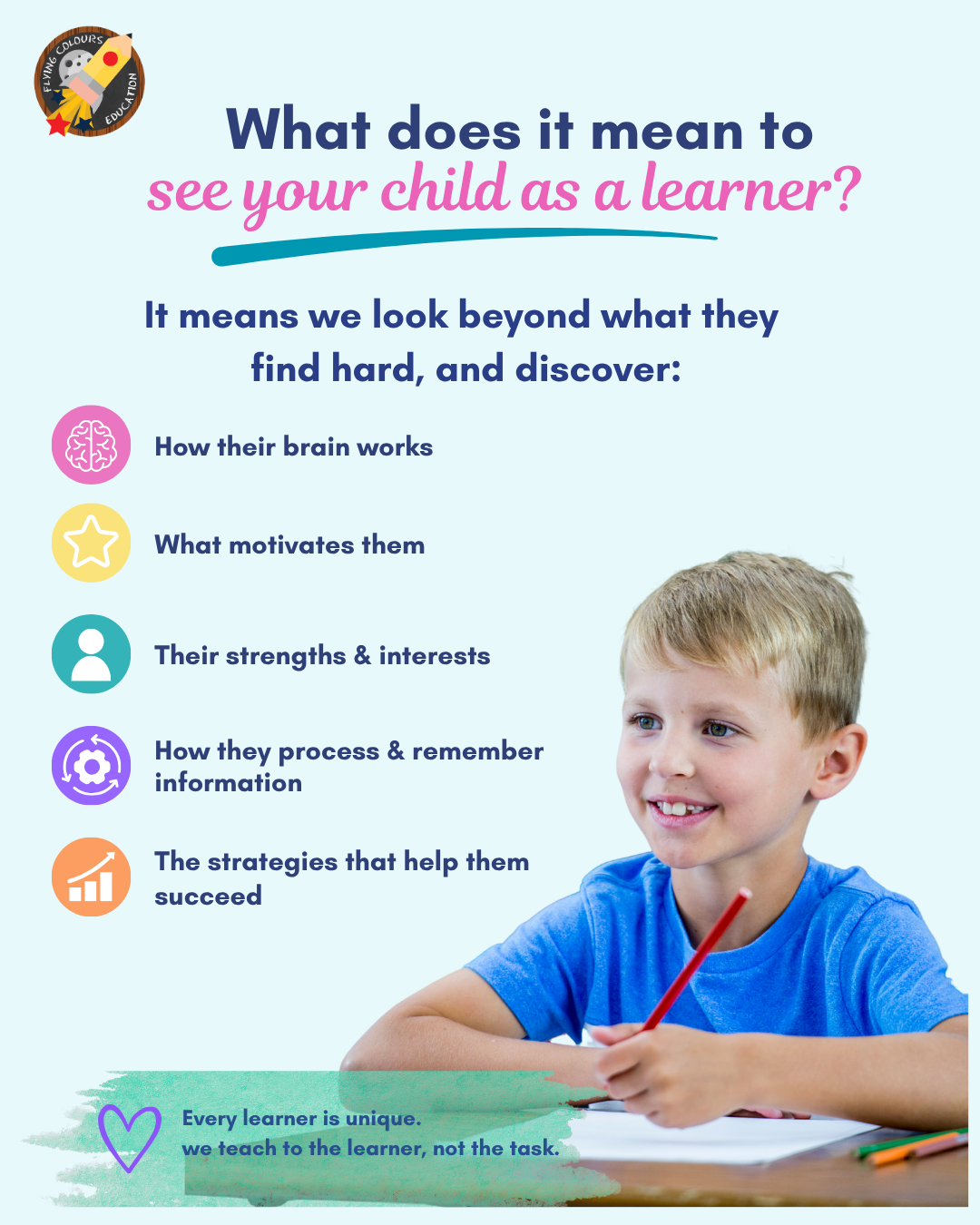
Understanding a child as a learner means looking at more than their marks, schoolwork or areas of difficulty.
We’re interested in questions such as:
-
What are their strengths?
-
Where does learning begin to break down?
-
How do they process new information?
-
What do they already understand?
-
What misconceptions may be getting in the way?
-
How much information can they comfortably manage at once?
-
Which strategies are they already using?
-
When do they need support?
-
When are they ready for greater independence?
-
What helps them engage and experience success?
Together, these observations help us develop a much richer picture of the learner.
And that allows support to become more purposeful.
The Same Difficulty Doesn’t Always Need the Same Intervention
This is one of the reasons we don’t believe in a one-size-fits-all approach to learning support.
A child who finds reading difficult may need support with phonological awareness, decoding, fluency, vocabulary, comprehension—or a combination of these.
A student struggling with mathematics might have gaps in foundational knowledge, difficulty retrieving number facts, challenges with mathematical language, or difficulty managing the cognitive demands of a multi-step problem.
Simply knowing that a child is “behind in reading” or “struggling with maths” isn’t enough.
We need to understand where learning is breaking down and why.
Only then can intervention be appropriately targeted.
Strengths Matter Too
Understanding a learner isn’t only about identifying difficulties.
It’s equally important to understand what a child does well.
A student may have excellent verbal reasoning but struggle to express their ideas in writing.
Another may have strong mathematical understanding but need additional support with processing written instructions.
Another may remember information particularly well when concepts are explicitly explained and connected to prior learning.
Recognising strengths gives us something to build upon.
Rather than defining children by what they can’t yet do, we can use what they can do to help develop the areas that need support.
Observing How a Child Learns
Some of the most useful information about a learner emerges while they’re actually learning.
That’s why observation is such an important part of effective intervention.
We notice things like:
-
how a student approaches an unfamiliar task
-
what they do when they become stuck
-
whether they ask for help immediately or persevere
-
which strategies they choose independently
-
the types of errors they make
-
how they respond to feedback
-
how much prompting they require
-
whether they can transfer a skill to a new situation
These details help us understand the thinking behind the performance.
A completed worksheet can show us an answer.
Watching the learning process can tell us much more.
Support Should Change as the Learner Changes
Understanding a child as a learner isn’t something we do once.
Children develop.
Skills strengthen.
Confidence changes.
New challenges emerge.
Strategies that once required significant support may eventually become independent.
That’s why effective learning support should be responsive.
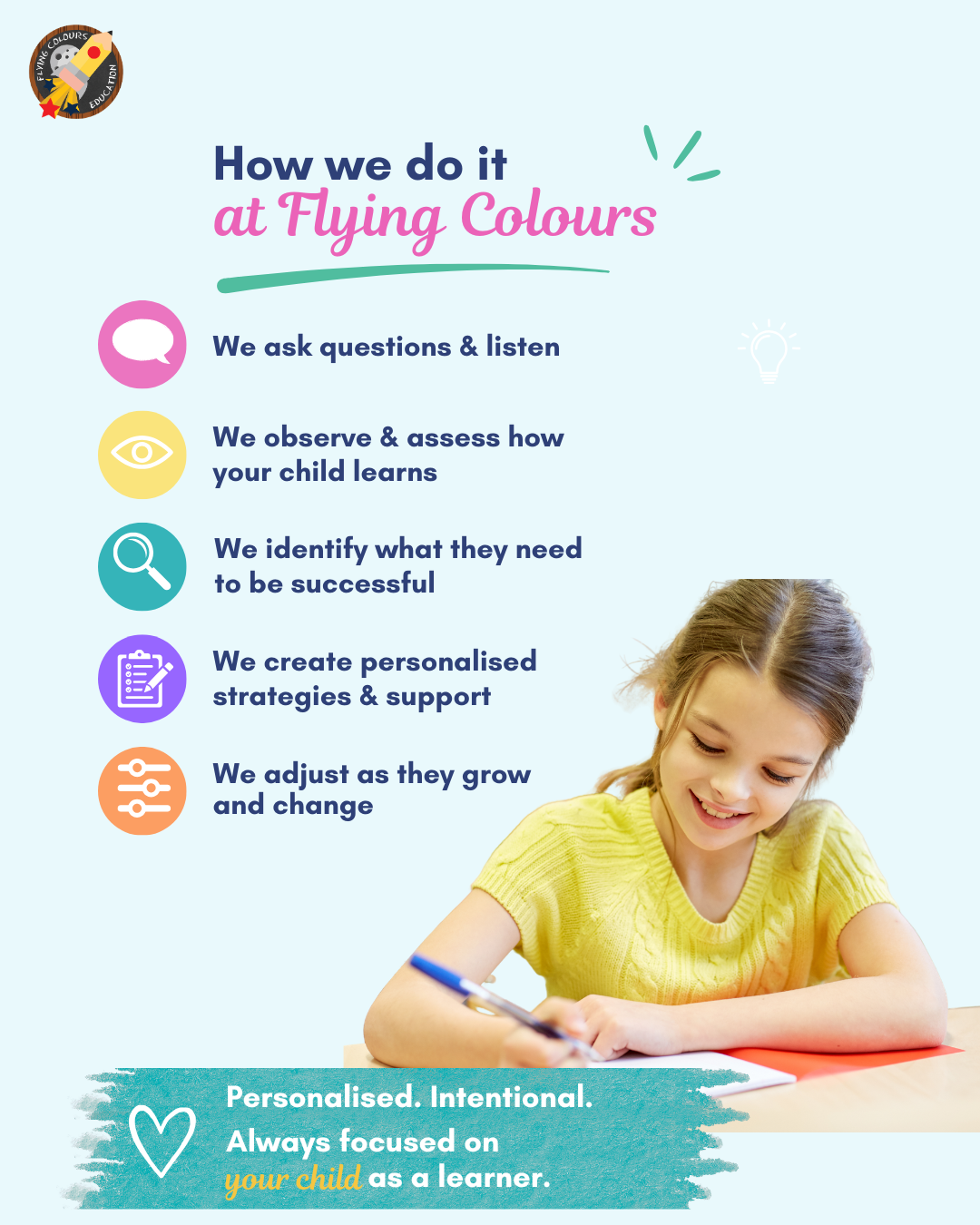
We assess.
We observe.
We teach.
We monitor progress.
We reassess.
And we use professional judgement to decide what needs to happen next.
The intervention evolves because the learner is evolving too.
From Support to Independence
Personalised learning support doesn’t mean making everything easier for a child.
And it certainly doesn’t mean providing more and more help.
In fact, the goal is the opposite.
We want to provide the right support at the right time, then gradually reduce that support as skills and confidence develop.
A student may initially need explicit modelling.
Then guided practice.
Then a prompt.
Eventually, they may need nothing at all.
That’s progress.
The goal isn’t for a child to become good at learning with us.
It’s for them to become increasingly capable of learning without us.