When parents think about identifying learning difficulties, they often think about assessments and test results.
While formal assessments provide valuable information, they only tell part of the story.
At Flying Colours, one of the most powerful tools we use is observation.
Observation allows us to understand not just what a child finds difficult, but how they approach learning, where they become stuck, what strategies they naturally use and what helps them succeed.
These insights enable us to provide learning support that is truly individualised and responsive to each child’s needs.
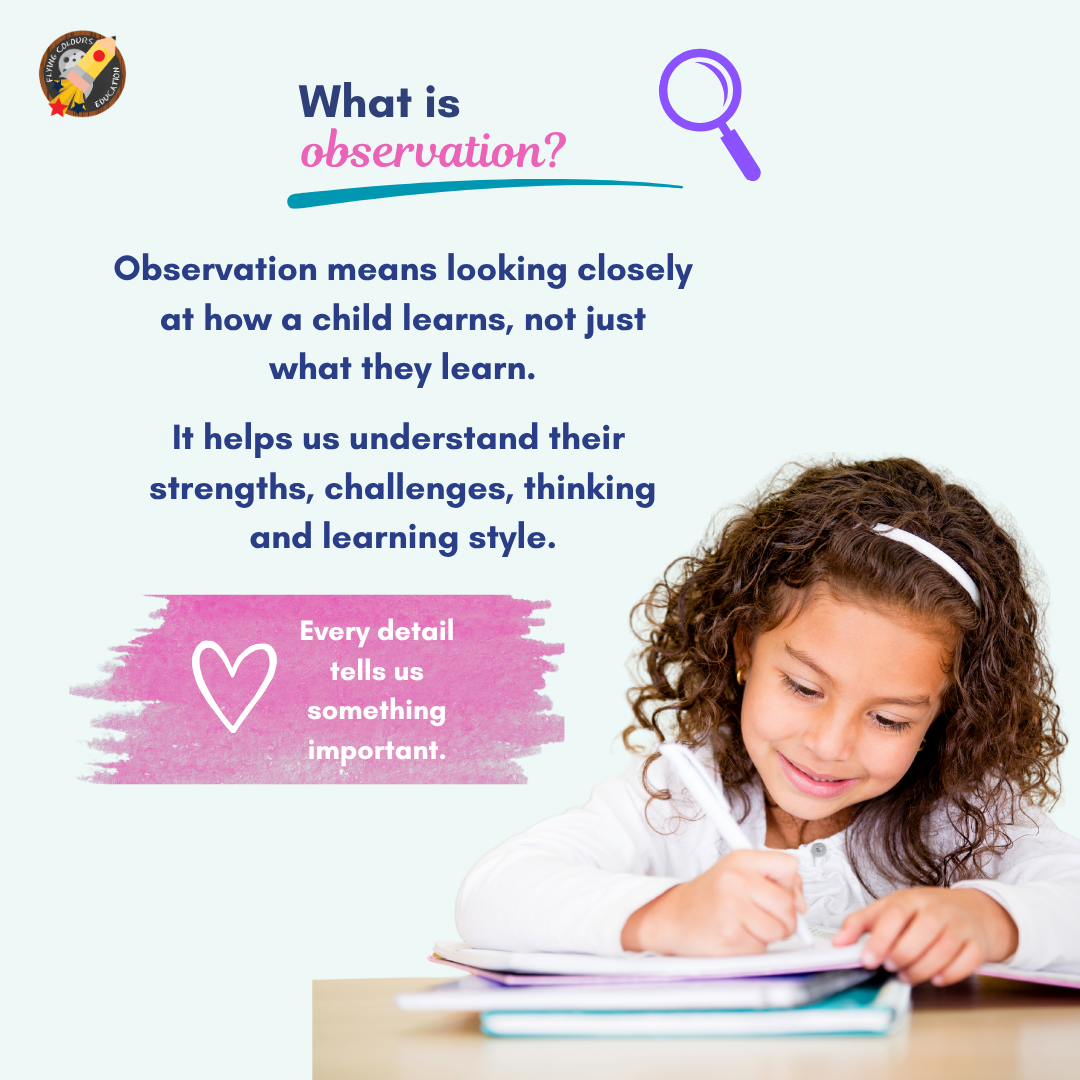
What Is Observation in Learning Support?
Observation is the intentional process of watching and analysing how a child learns during everyday learning activities.
Rather than simply recording whether an answer is right or wrong, we look at questions such as:
- How does the child approach a new task?
- Do they rush or hesitate?
- Which strategies do they naturally use?
- What happens when they make a mistake?
- When do they lose confidence?
- Which teaching approaches produce the greatest success?
These observations provide valuable information that cannot always be measured through standardised assessments alone.
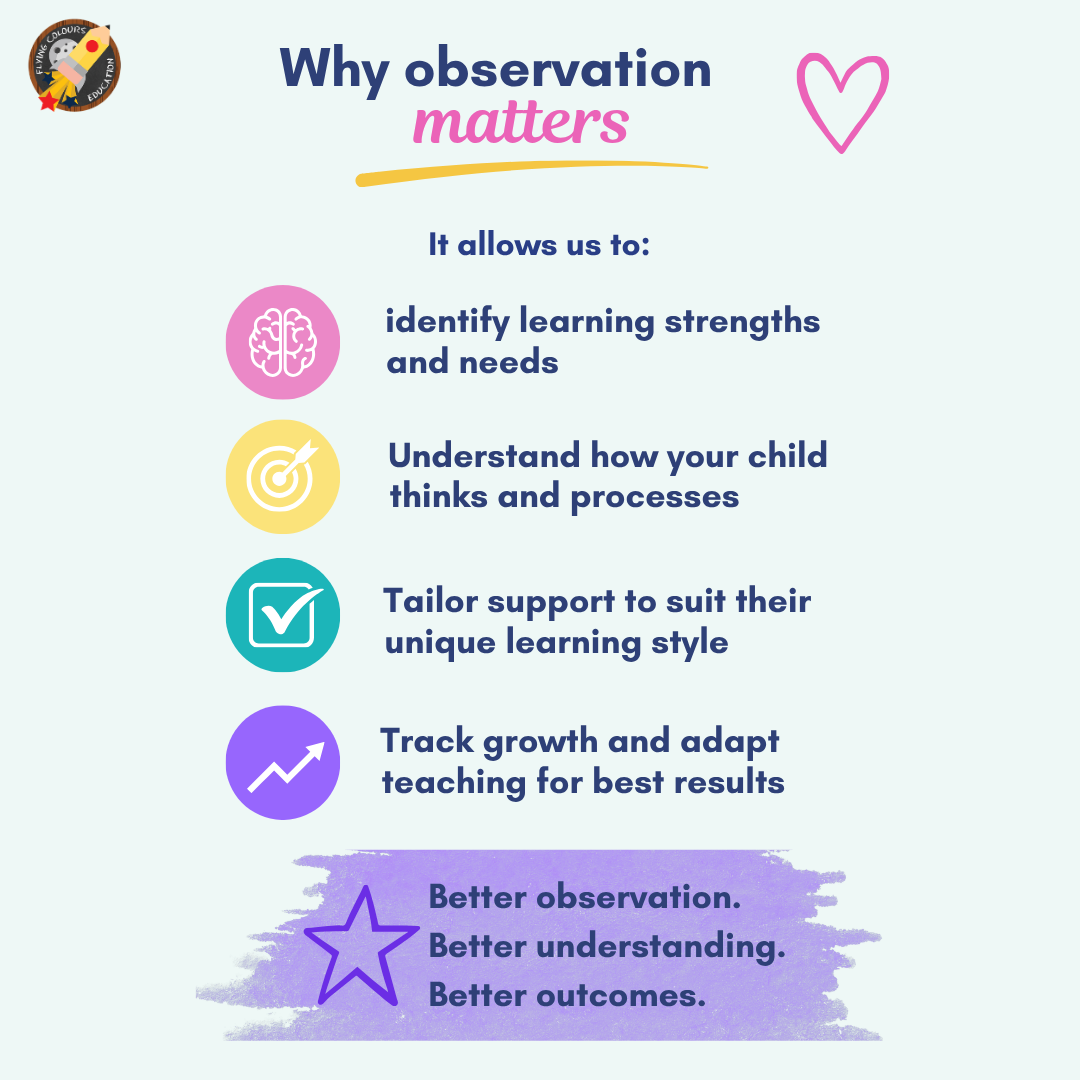
Why Observation Matters
Learning is far more complex than a test score.
Two children may achieve exactly the same assessment result but require completely different intervention because the reasons behind their difficulties are different.
Observation helps us identify the underlying processes influencing learning.
For example, we may observe that a child:
- guesses unfamiliar words rather than decoding them
- avoids challenging tasks
- loses concentration after a short period
- forgets multi-step instructions
- becomes anxious when faced with new learning
- responds particularly well to visual supports or movement
These observations help us understand the child as a learner, not just as a set of scores.
The Research Behind Observation
Observation is a well-established part of evidence-based educational practice.
Research consistently shows that effective teaching relies on ongoing formative assessment, where educators continuously gather information about a student’s understanding and adjust instruction accordingly.
Observation allows practitioners to:
monitor progress in real time
identify misconceptions early
adjust teaching strategies
ensure learning remains appropriately challenging
provide timely support
Rather than waiting until the end of a concept to discover a child has struggled, observation allows support to be adapted as learning happens.
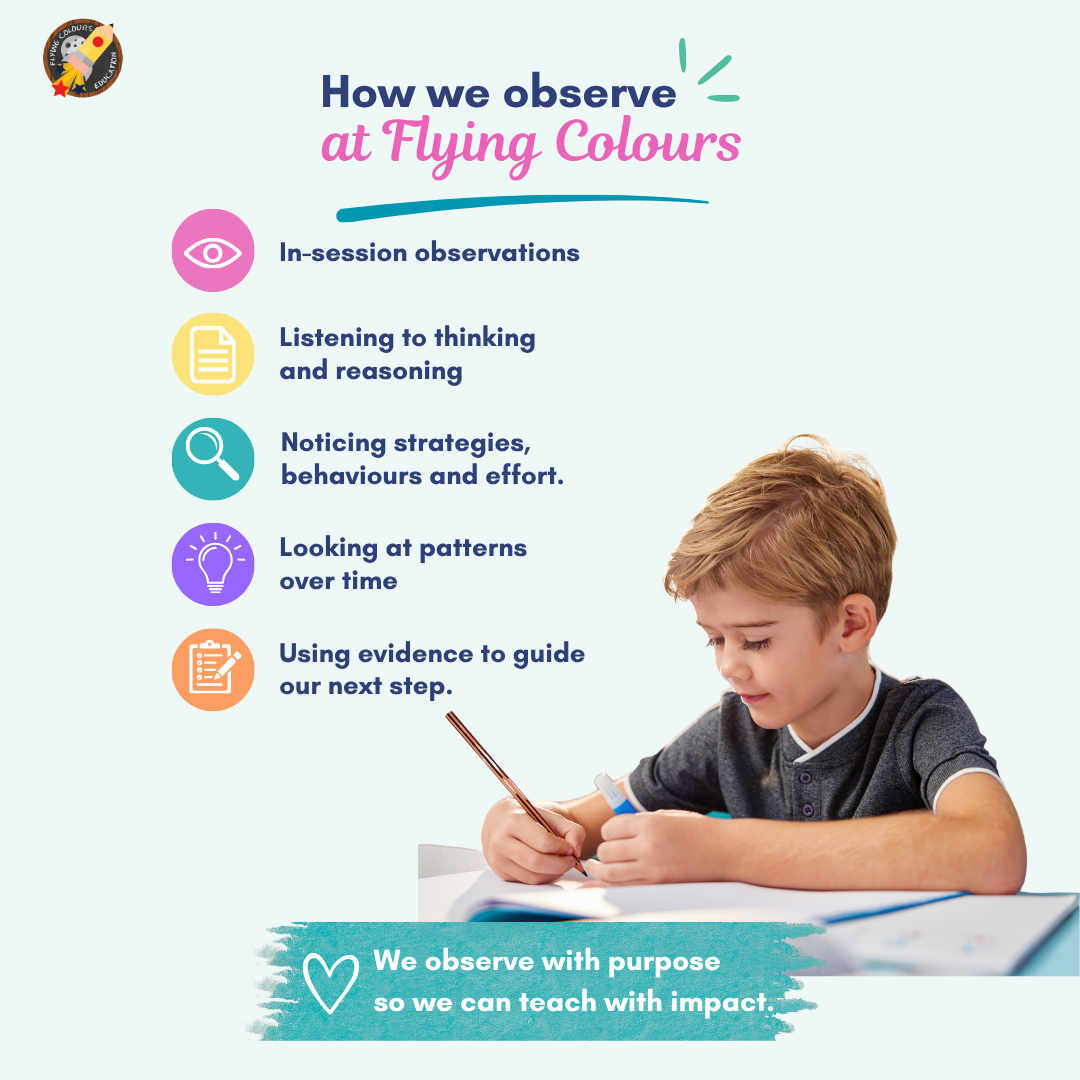
What We Observe at Flying Colours
Observation is embedded into every session we deliver.
Our educators continually look for patterns in how children learn, including:
Learning behaviours
We observe:
- attention and engagement
- persistence
- organisation
- willingness to attempt new tasks
- response to feedback
Thinking processes
We consider:
- How does the child solve problems?
- Are they relying on memory or understanding?
- Can they explain their thinking?
- Are they transferring previous learning?
Emotional responses
Learning is closely connected to emotions.
We observe:
- confidence
- frustration
- anxiety
- resilience
- motivation
These responses often tell us as much about a child’s learning needs as their academic performance.
Response to Different Teaching Strategies
Every child responds differently to different approaches.
Through observation we identify whether a child benefits most from:
- explicit instruction
- multisensory learning
- visual supports
- repetition
- movement
- scaffolded practice
This helps us continually refine our teaching to suit the individual learner.
Observation Is Ongoing, Not One-Off
One of the biggest misconceptions is that once an assessment has been completed, the learning plan is fixed.
At Flying Colours, observation continues throughout every session.
As children develop new skills and confidence, we adjust our teaching to match their progress.
This ongoing cycle of observing, teaching, reviewing and adapting ensures that intervention remains responsive and effective.
Why This Is Different from Traditional Tutoring
Traditional tutoring often focuses on completing homework or preparing for the next classroom assessment.
Specialised learning support looks much deeper.
Instead of asking:
“Did they get the answer right?”
We ask:
- How did they solve the problem?
- What thinking process did they use?
- Which skills are becoming automatic?
- Where is learning breaking down?
- What support will help them succeed next?
This continuous observation allows intervention to evolve with the child.
The Benefits of Observation
Through ongoing observation, we can:
- identify learning barriers earlier
- personalise teaching strategies
- monitor progress accurately
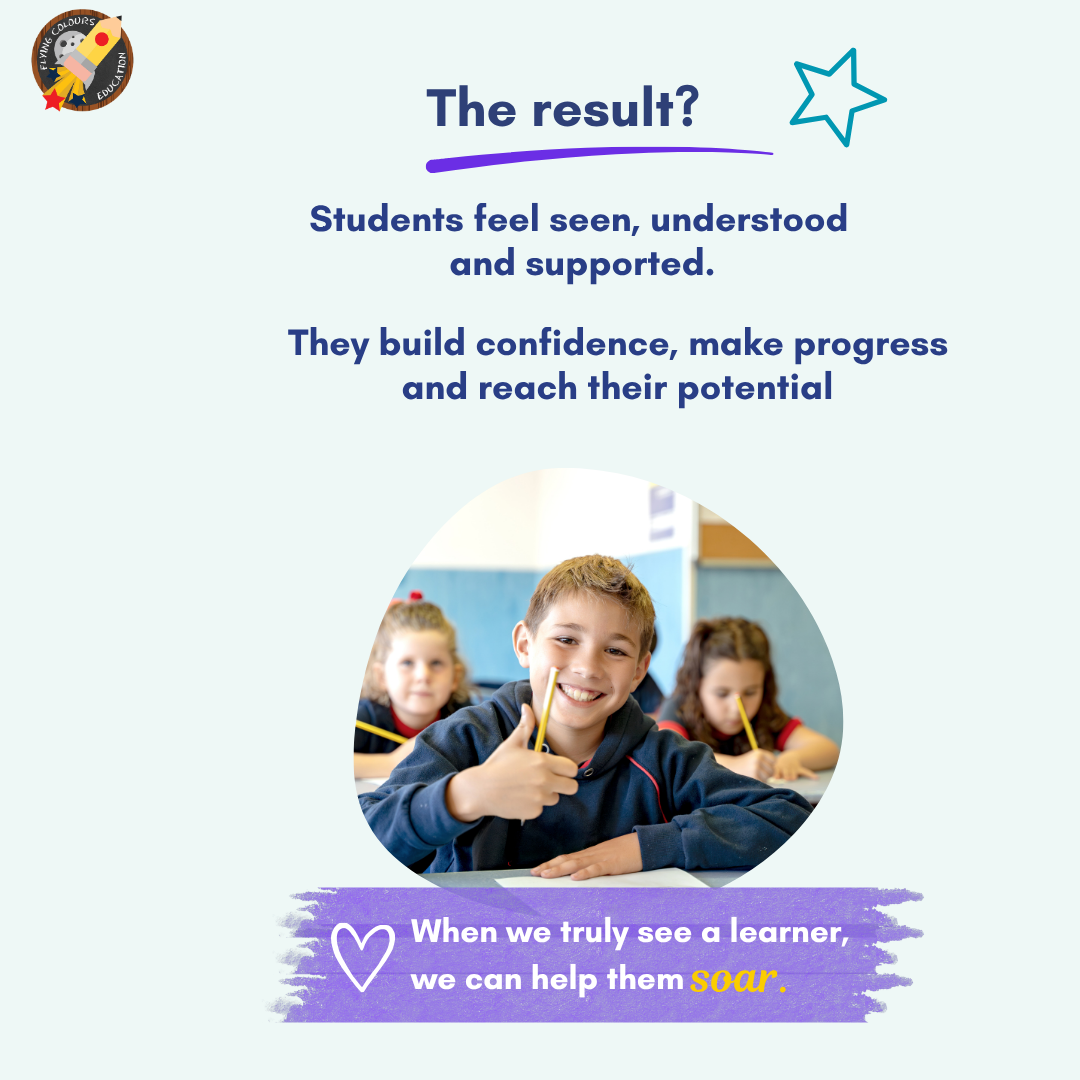
- build confidence alongside academic skills
- adapt intervention as children grow
- celebrate meaningful progress, not just marks
Observation helps ensure every child receives the support they need at the time they need it.
At Flying Colours, observation is much more than simply watching a child complete a task.
It is an essential part of understanding how each child learns, allowing us to provide evidence-based, individualised support that evolves as they grow.
If your child is finding learning challenging, we’d love to help them discover the strategies that work best for them.
Every child tells us something through the way they learn.
By combining formal assessment with careful, ongoing observation, we gain a much deeper understanding of each child’s strengths, challenges and potential.
Because when we truly understand how a child learns, we can provide the right support to help them soar.