
When a child is struggling at school, many parents naturally think the solution is tutoring.
But for some children, the challenge is not simply about needing more practice or extra help with homework.
Often, there are underlying barriers to learning that make it difficult for a child to process information, retain new skills, stay organised or keep up in the classroom.
Understanding these barriers is an important first step in identifying the right kind of support for your child.
What Are Barriers to Learning?
Barriers to learning are underlying difficulties that impact a child’s ability to access, process, retain, or apply information effectively.
These barriers can affect:
- reading and literacy
- maths and numeracy
- attention and concentration
- memory
- organisation
- emotional regulation and confidence
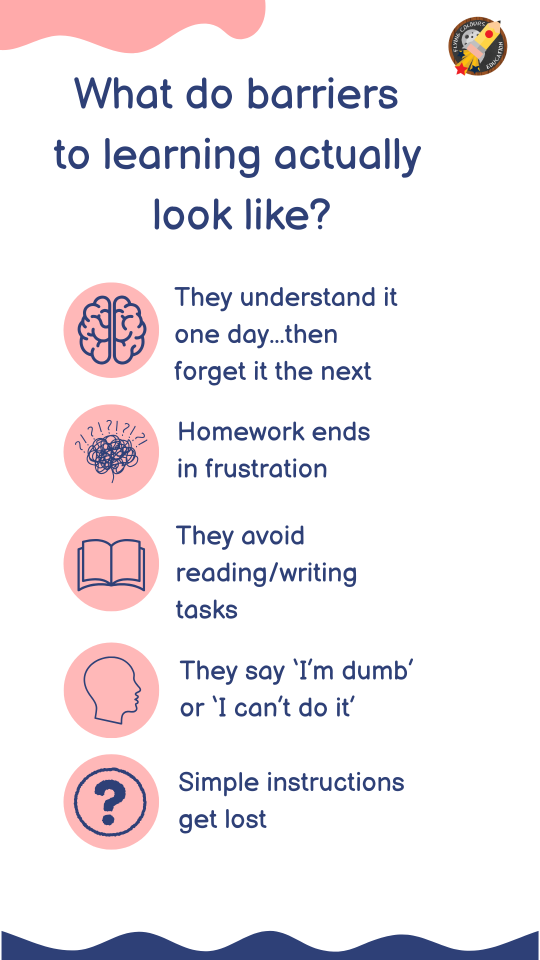
For many children, these challenges are not always obvious at first. Instead, they may appear as:
- falling behind at school
- frustration during homework
- avoidance of learning tasks
- low confidence
- difficulty staying focused
Common Barriers to Learning
Working Memory Difficulties
Working memory is the ability to hold and use information in the moment.
Children with working memory difficulties may:
- forget instructions quickly
- lose track of steps in tasks
- struggle to retain new information
- find multi-step activities overwhelming
This can make classroom learning feel exhausting and frustrating.
Processing Overload
Some children experience difficulty processing large amounts of information at once.
In busy classroom environments, they may become overwhelmed by:
- verbal instructions
- noise and distractions
- multiple tasks
- fast-paced learning
When processing overload occurs, children may:
- shut down
- become frustrated
- appear distracted or disengaged
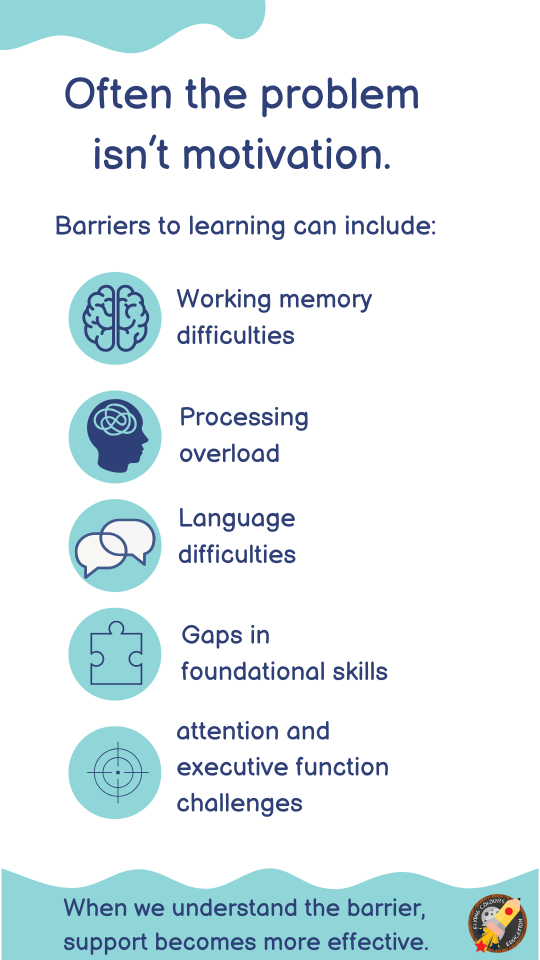
Language Difficulties
Language plays a major role in learning.
Children with language difficulties may struggle to:
- understand instructions
- express their thoughts clearly
- process verbal information
- develop reading comprehension skills
These challenges can affect both academic progress and confidence in the classroom.
Gaps in Foundational Skills
Sometimes children develop gaps in core learning skills that make future learning more difficult.
For example:
- weak phonological awareness can affect reading
- gaps in number sense can impact maths understanding
- missed foundational concepts can create ongoing struggles
Over time, these gaps can become bigger if they are not identified and addressed.
Attention and Executive Function Difficulties
Executive functioning refers to the brain’s ability to:
- plan
- organise
- stay focused
- manage time
- regulate attention and behaviour
Children with executive functioning difficulties may:
- struggle to start tasks
- become easily distracted
- forget materials or homework
- have difficulty managing routines
These challenges are often misunderstood as laziness or lack of effort, when in reality the child may be working incredibly hard.
Why Tutoring Isn’t Always Enough
Traditional tutoring often focuses on:
- completing homework
- revising classroom content
- practising academic skills
- addressing content for their current grade
While this can help some children, it may not address the underlying barriers causing the difficulties in the first place.
For example:
- practising reading alone will not resolve working memory difficulties
- extra maths worksheets may not address processing overload
- repeated homework support may not improve executive functioning skills
This is why some children continue to struggle even after receiving tutoring.
The Difference with Learning Support
Specialised learning support focuses on understanding why a child is struggling, not just what they are struggling with.
At Flying Colours, learning support is designed to:
- identify underlying barriers to learning
- build foundational skills
- develop learning strategies
- support confidence and resilience
- create individualised approaches for each child
This allows children to build stronger learning foundations rather than simply “keeping up.”
The Emotional Impact of Learning Difficulties
Barriers to learning don’t just affect academic performance. They also impact emotional well-being.
Children may begin to feel:
- frustrated
- anxious
- embarrassed
- “not good enough”
Over time, this can reduce confidence and willingness to engage with learning.
This is why supporting both learning and emotional well-being is so important.
When to Seek Learning Support
It may be helpful to seek specialised learning support if your child:
- continues to struggle despite tutoring
- becomes overwhelmed by learning tasks
- avoids schoolwork
- loses confidence easily
- has difficulty retaining information
- experiences frustration or emotional shutdown around learning
Early support can make a significant difference in both learning outcomes and emotional well-being.
At Flying Colours, we provide specialised learning support that looks beyond surface-level struggles to understand the underlying barriers impacting your child’s learning.
Our goal is to help children build confidence, develop strong learning foundations, and experience success in a way that works for them.
When a child is struggling, it’s important to understand that the issue is not always effort or motivation.
Often, there are underlying barriers to learning that need the right support and strategies to be properly addressed.
With specialised learning support, children can build the skills, confidence, and resilience they need to thrive both at school and beyond.